Kyrgyztan - Nomad Tour
Unpredictable weather, mountain passes, and a tireless fox turn the “Nomad Trail” through the Kyrgyz Tian Shan Mountains into a true adventure. Amid an improvised campsite, heavy rain, and warm hospitality, one thing becomes clear: the best journeys often begin with surprises.
The trail’s starting point in Jyrgalan is unusual. The four horses are “parked” next to the bumpy road around a slightly crooked traffic sign, flanked by several men who are eyeing me curiously. No wonder the locals find me a bit unsettling: for one thing, I’m the first tourist on this trail, and for another, I’m traveling alone as a woman with three men. And to be honest: even I’m not entirely comfortable with the situation at that moment, and as I drift off to sleep in the tent about ten hours later, I wonder if riding with three men I don’t know in the middle of nowhere in Kyrgyzstan is a good idea. But I quickly push the thought aside, and for the rest of the trail, I won’t worry about it even once. On the contrary: the solitude of the mountains, my three attentive escorts, and my tireless chestnut gelding turn out to be a perfect combination.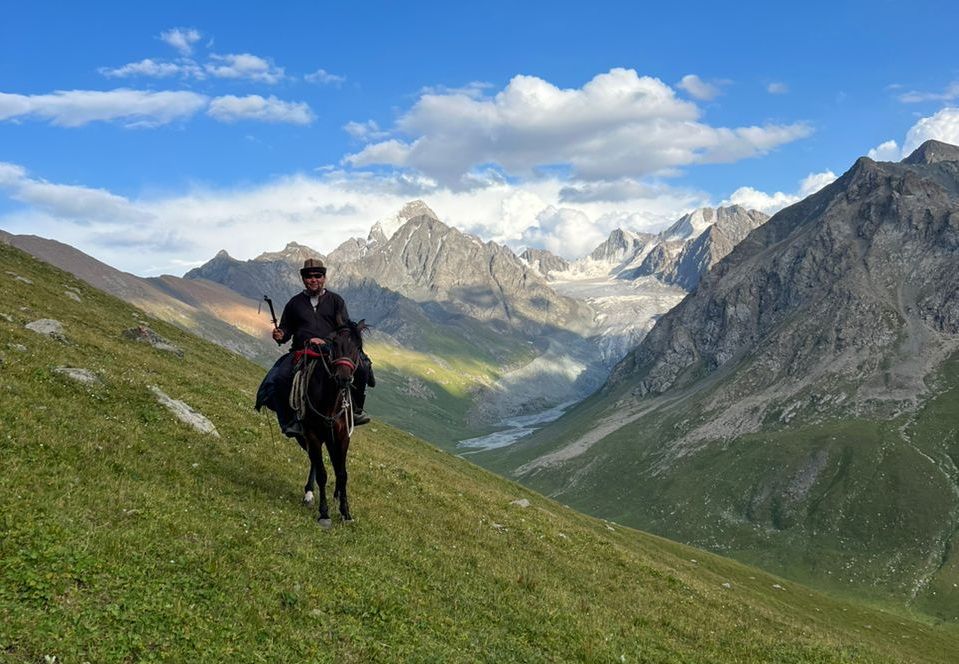 I quickly pack my two luggage bags—wrapped in black plastic bags—into the saddlebags provided. Two of the men adjust the stirrups and gallantly help me onto the horse. After about ten meters, we leave the gravel road, ride along a little stream gurgling softly, and finally climb up a steep slope. As the last roofs of Jyrgalan disappear, civilization vanishes behind the trees. Our guide, Azamat, rides ahead, closely followed by Nursultan, the young guide who is getting to know the route, as well as Mirlan, the translator and head of Nomad Trails, and me. As we ride on, the trails narrow into narrow paths, which become increasingly rough and rocky until, in some places, they disappear into meadows dotted with colorful flowers, while dark clouds pile up one on top of another above the snow-capped peaks all around us. About an hour before we reach our destination for the day, the men start to get flustered. In a flash, they pull two tents out of their saddlebags and set them up in a somewhat sheltered spot near a large stone block lying in the meadow. Shortly afterward, it starts to rain and doesn’t stop for several hours. I lie in the tent and listen to the rain hammering ceaselessly against the tent walls, interrupted only by Mirlan, who hands me a glass of cognac through the tent entrance to cheer me up. The heavy downpour forces us to set up camp here, on the wrong side of the pass. We had actually planned to descend further down the other side of the mountain, but now we’re spending the night higher up than we’d intended. Still, everything goes smoothly: Our makeshift campsite is well-chosen, my tent stays dry, and the sleeping bag I brought keeps me warm enough.
Three Gentlemen
It’s cold in the morning, the sky is blue, and the sun’s rays haven’t yet reached our campsite because of the high peaks all around us. After breakfast, we quickly take down the tents, then saddle and pack the horses. Before we climb the 3,362-meter-high Boz-Uchuk Pass, we have to cross a river that makes me uneasy because of its fast current and unpredictable depth. But Azamat knows what to do: We cross the water together so that I can focus on lifting my legs high. My shoes stay dry—but only for a while, because the rain proves to be a constant companion, whereas my now-leaky hiking boots do not: For the rest of the trail, my morning ritual involves wrapping my feet in black plastic wrap.
When the wind picks up after our lunch picnic and the morning’s blue sky has given way to a mass of gray clouds, Azamat and Nursultan suddenly leap off their horses. Nursultan unties the cords around a lime-green package behind my saddle and unfolds a raincoat from it. The two guides help me into the coat like consummate gentlemen. But that’s not all: They show me how the cone-shaped buttons work, button everything up, and Azamat secures one of the cones with a small metal clasp before putting the hood on my head. I smile at the situation and test my meager Kyrgyz with a grateful “Chong rachmat.” Since we lack a common language, communication with the two guides relies more on pantomime... . When Mirlan is nearby, he translates for me. As the rain gets heavier, the outlines of the cattle scattered across the pasture become increasingly blurred. I snuggle into the beautifully colored Russian raincoat, made in 1984, and am glad for the raincoat, which shields me from the dreadful weather like a large tent.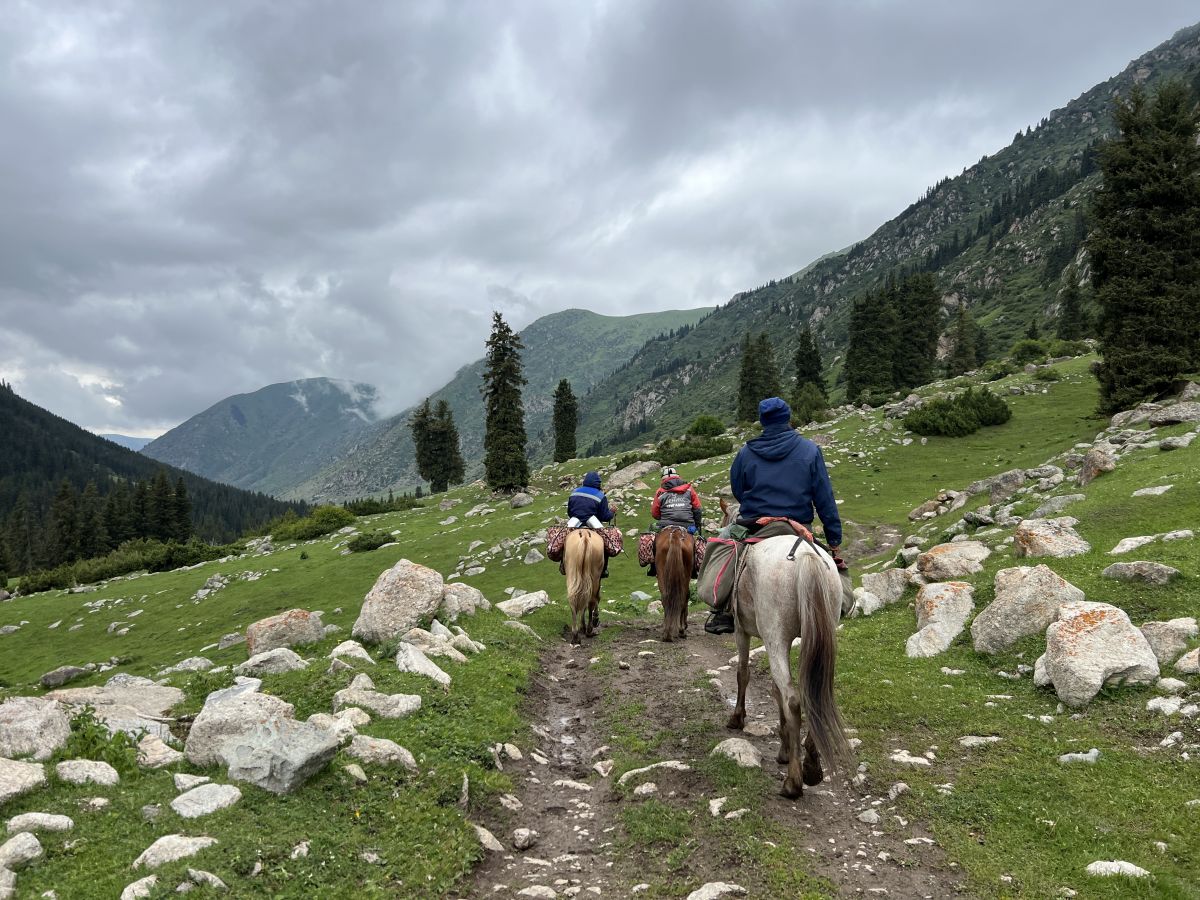
Test subject with a new bed
As the thunderstorm rages right above us with lightning and thunder, it doesn’t take long for the raindrops to freeze into small hailstones that get caught in my chestnut gelding’s mane; later, it snows briefly. Kashka seems a bit uneasy about the lightning and the loud rumbling: I can sense my horse’s impatience, and gradually the animals’ brisk walk turns into a trot and a mincing step. Although I actually dislike riding in the rain, I find myself smiling happily to myself. We skip the lake, located at over 3,500 meters, that was on the itinerary. Instead, the weather treats us to a thick fog, from which a small section of a snow-capped mountain keeps flashing into view like a washed-out theater prop. When we arrive at the camp—which consists of two yurts and a wooden shed—we’re treated to chai, bread, raspberry jam, and kaymak. The guides generously stir the thick, spreadable cream into the tea, and I follow their example. While the men leave the heated yurt after their snack, I stay behind, because according to Mirlan, my “room is not ready.” There’s a constant coming and going in the yurt: people are stoking the fire, chatting, eating, then resting briefly on the blankets spread out on the floor. I listen to the voices, read, take notes, and enjoy the warmth of the stove. Through the open door, I can see that the light-colored wooden planks in front of the yurt are getting fewer and fewer. Later, I realize that the guides have built me a brand-new bed. When Mirlan shows me my quarters, including the bed for the night, I ask, “Where do you sleep?” “With the family in the other yurt,” comes the reply. Taking an entire yurt just for myself doesn’t seem right to me, considering how many people are here. I offer to share it.
The next day, we ride toward Almaluu, where we visit the waterfall in the Jerges Valley that the locals call “Niagara” because of its impressive cascades. After lunch, we set off for the 3,516-meter-high Ailanysh Pass. The peaks of the Tian Shan Mountains—which translates to “Heavenly Mountains”—seem to draw closer the higher we climb on horseback. After passing several lakes, a cliff face rises before us, with a thin, jagged scar carved into its center: the trail that will lead us over the mountain. Azamat, riding ahead on his chestnut, keeps stopping. His stallion is tired. At a tricky spot, the horse’s hind legs buckle briefly; Azamat jumps off and lets him rest. To the left, the mountain drops steeply; to the right, the path climbs over rocky terrain. Kashka and I pass the stallion on the narrow trail. In Kyrgyzstan, people ride almost exclusively on stallions, while the mares’ role is to raise the young. Since I’m the first tourist on this trail, they were probably unsure whether I could handle a stallion. Kashka, the approximately four-year-old gelding assigned to me, climbs upward like a well-oiled machine. He conquers every rocky step with ease, carrying me with his ears pricked as we cross the mountain passes, through streams and rivers. He’s friendly, eager to move forward, and curious. Given the steep slope, I know that mistakes aren’t a good idea here, but Kashka has only one thing on his mind anyway: moving forward. Once at the top, I have to navigate a few meters of deep snow. I follow the deep tracks left by Nursultan and Gulsary, the handsome palomino stallion. My three companions keep checking my expression, trying to gauge how I’m doing. To their questioning glances, there’s always just one answer: “All good.” As I say this, I give a thumbs-up with a broad grin.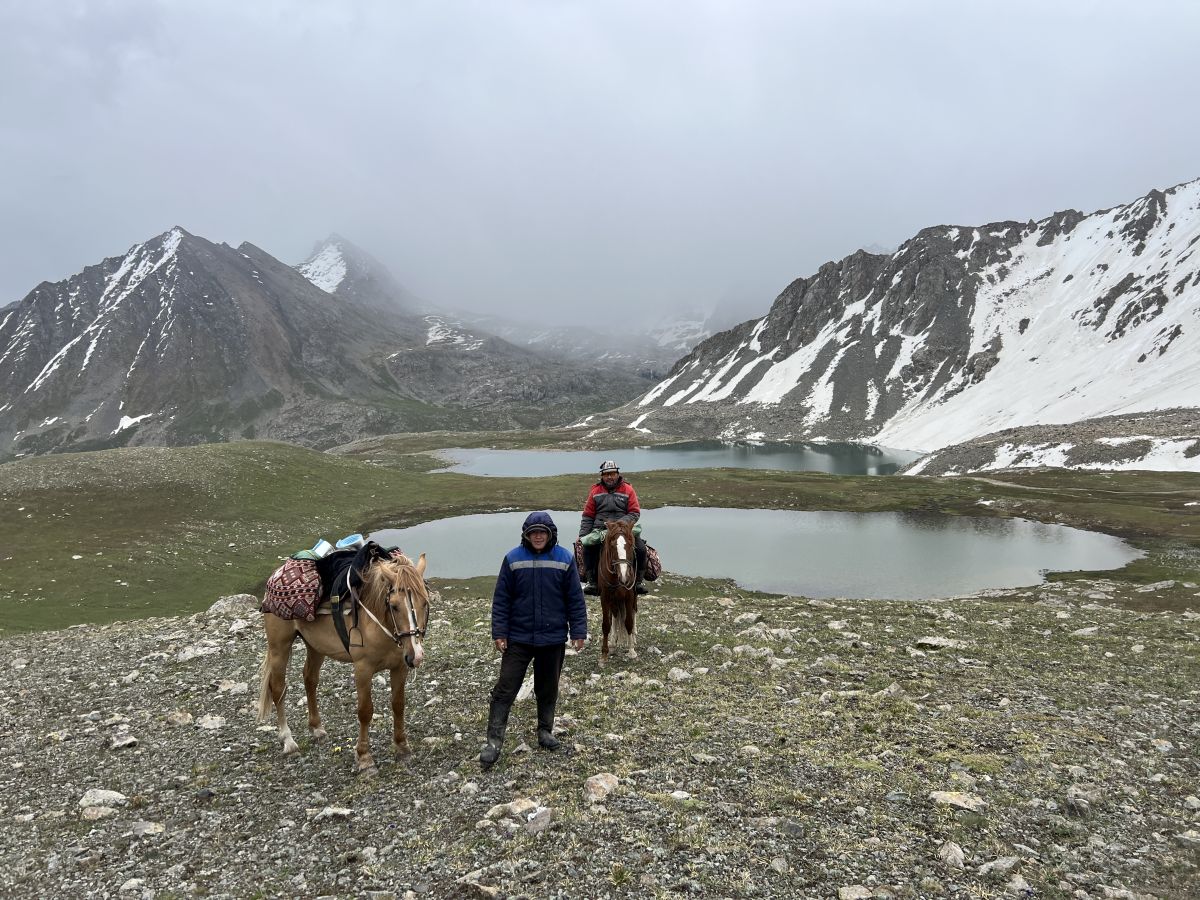
Goat Brain for Breakfast
The camp in the Ak-Suu Valley consists of a yurt and a long, narrow wooden building, at the back of which the family eats and sleeps comfortably on a pile of blankets. As a guest, I’m given a place of honor next to the eldest. So the farmhand—who, among other things, tends to the cows and sheep grazing near the yurt—and I are the first to be served tea and food. Along with a bowl of hot, aromatic soup, we’re served oromo. These steamed dough rolls are made of thin noodle dough and filled with meat and a hint of vegetables. Later, I notice that the host is working on a misshapen bone with a knife. Since there’s no electric light and the room is only dimly lit, I can’t quite make out what he’s working on and ask: it’s a goat’s head. As he picks the eyes out of their sockets, I’m briefly afraid that, as a guest, this delicacy will be served to me. But I’m in luck, and the 13-year-old son reaches for it… Mirlan explains that in Kyrgyzstan, everything is eaten: nose to tail. To contribute to the conversation, I ask if I can try the goat’s brain. Of course… But the skull turns out to be hard—and the taste test doesn’t happen just yet. The herders are curious and want to know what horses in Europe look like, why male tourists always ride poorly while their female counterparts always ride well, exactly what kind of work I do, and how many countries I’ve already traveled to… Later, the women ask me to show them a photo of my “husband.” As we sit across from each other the next morning over a sort of porridge for breakfast, we gossip, laugh, and joke around. Mirlan translates the questions, and I cheekily remark, “I’m still waiting for my goat brain!” The host doesn’t need to be told twice. After a few minutes of fiddling around, he hands me what I asked for in a small bowl. I spread some brain on a piece of bread and take a bite. He nods approvingly.
Change of Plans
It snowed overnight in the mountains, and the pass between us and Altyn Arashan is too dangerous in these weather conditions. Although I’m a little sad to miss the view of the glacier, I’m also glad the guides decided to take the safe route. We ride along the Ak-Suu Valley and the blue-white glistening glacial river, on whose banks herds of cattle and horses graze. On a hillside, we watch a flock of sheep flowing across the green meadow like a fraying mass, kept in line by two riders and their dogs. Just a few hundred meters from the camp lies a dead foal, killed by a wolf, according to Azamat. Elsewhere, the experienced guide points out a strangely large excavation site to me, where a brown bear dug up a marmot in the winter for a warm meal.
Kumys, Kamcha, Kok-Boru
Nursultan, who at 24 is the baby of our group, is not only an experienced shepherd but also a player in the Kyrgyz people’s traditional national sport: Kok-Boru. The goal—which sounds barbaric to European ears—is to drive a dead goat into the opponent’s goal. When Azamat loses his kamtscha—the traditional whip made of leather and wood—Nursultan deftly picks it up from his horse. Whether at a walk, trot, or gallop makes no difference to the young man… Later, when I visit the livestock market and bazaar in Karakol with Mirlan, a saddler shows us his handcrafted Kok-Boru saddles. In the covered hall, where bridles, horseshoes, kamchags, leg guards for kok-boru players, and much more are sold, I buy a pair of Kyrgyz leather boots like the ones Nursultan and Azamat wear, earning surprised glances from some of the locals. After a glass of kumys—fermented mare’s milk—I ask Mirlan to show me where the Russian raincoats are sold. But the selection is limited and nowhere near the quality I’m used to from the one Mirlan lent me. Mirlan sees the failed coat purchase as an opportunity, since it means I’ll have to come back, as he remarks mischievously