Colombia Hacienda Trail
Colombia, January 2025
The trips to Namibia in November and Tierra del Fuego in December didn’t happen. The dates were simply too close on the heels of the Lesotho Trail in October, and I didn’t feel fit enough. So I ended up joining a friend in Colombia in January after all, even though it wasn’t on my ‘to-do list’ and the trip – an absolute no-go for a skier – meant I’d have to miss out on my usual weekend skiing at the start of the year. At least, given the proximity to the equator, summery temperatures were to be expected, meaning I could travel light, especially as the hacienda tour promised slightly more luxurious accommodation, so there was no need for a sleeping bag and the like.
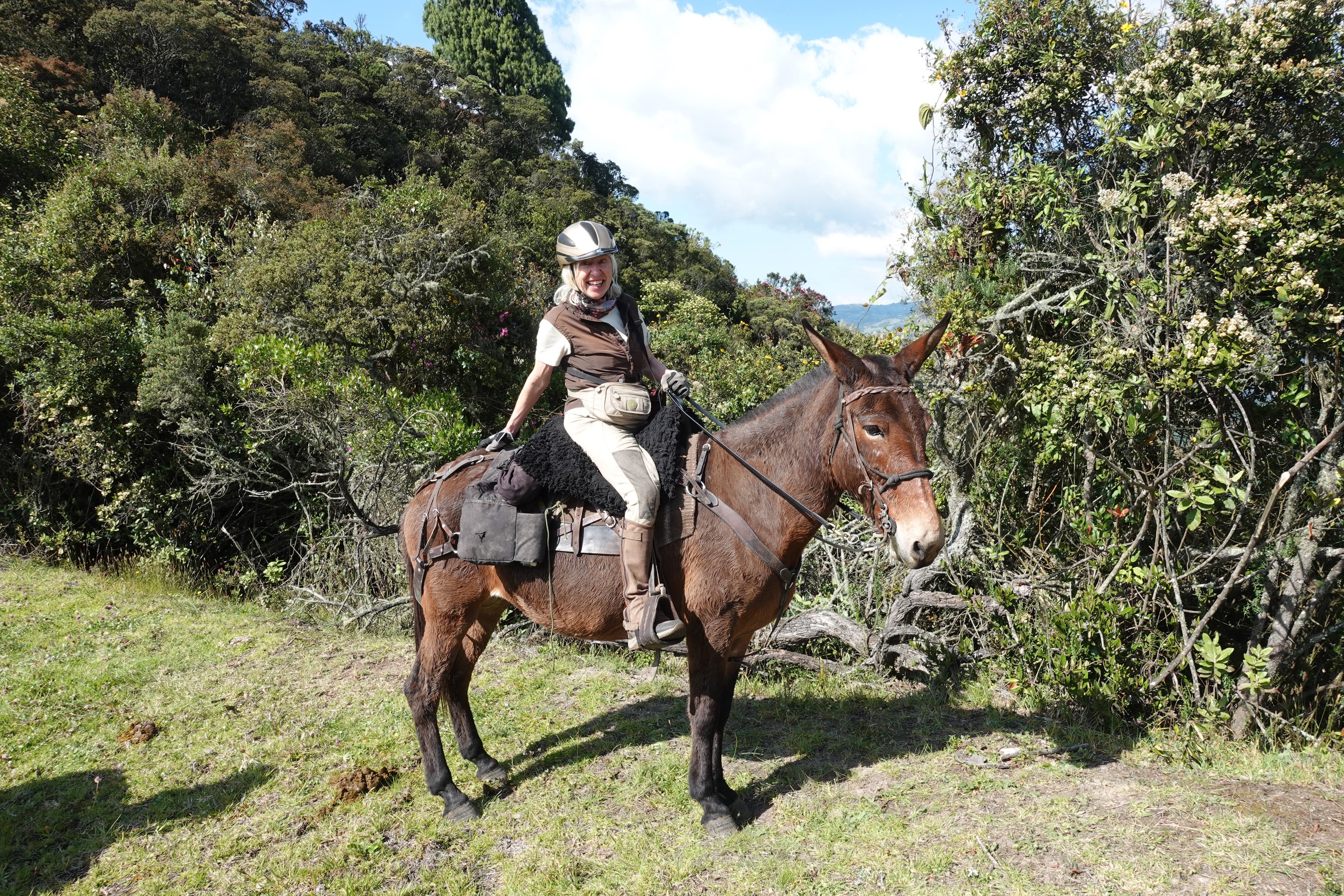
Even so, as always, I found the decision of what to pack quite stressful. Instead of getting better, things actually got worse over the course of my 80 or so trails. And that’s despite the fact that, about two years ago, when my checked luggage failed to turn up, I managed effortlessly to get by for 10 days with just my hand luggage, as it contained (almost) everything I needed, especially my riding clothes.
The next sticking point in Munich was the S-Bahn. I’d left the house on time and had just had my ticket stamped when an announcement left me frozen in my tracks: due to points repairs, the S-Bahn was only running as far as Neufahrn today, meaning it wouldn’t go all the way to the airport. The fact that there was a rail replacement service at the announced terminus was, ‘of course’, not mentioned. Oh well, I was delighted to discover this alternative at the premature terminus, after I’d managed to dissuade an English-speaking porter from taking another line that would have taken at least twice as long, suggesting that we could share a taxi to the airport together. And it took some assertiveness to secure a seat in that large rail replacement taxi. But I was used to that sort of thing from countries like Tunisia, where people are always jostling for a seat. Oh yes, and then there was the vexing Munich Airport. The route to check-in was miserably signposted. Despite having checked in online (which I’d managed in a whopping three hours, even though, according to Air Europa’s information, it isn’t possible), there was no baggage drop-off counter. I had to join the long queue of those who hadn’t yet checked in. Well, I knew how to avoid the wait thanks to a cheeky attempt at the empty business class counter.
After the hand luggage check, just before the gate, there was Barbara, sitting there with the dark red neck pillow that I’d spotted lying on the floor en route and left there – no idea how she managed to slip past me with it without me noticing. All the fuss was over. The journey could begin. And it was well worth all the stress beforehand.
And it got off to a great start. The seats next to me on the first leg of the flight to Madrid were empty, so I was able to get a good two hours’ sleep. We landed on time, the connecting flight was on time, and we arrived in Bogotá in the evening. If only I hadn’t had a gnawing hunger, as there was only one meal served during the entire 14-hour flight and just a cup of tea before disembarking. A disgrace for such an expensive flight. And it would also have been good if we’d spotted Barbara’s luggage sooner. Whilst mine was the third piece to arrive as we stood by the carousel, her bag simply didn’t turn up. Until we finally looked around and realised that it had been taken off the carousel (presumably during the hour it had taken us to get through customs and walk the long distances). But never mind, the taxi we’d booked had been waiting and took us reliably to Retiro 84, where we were due to be picked up the next morning for the tour. And there, despite the late hour, they even made us a sandwich to satisfy our hungry stomachs.
Day 1, Saturday 11 January.
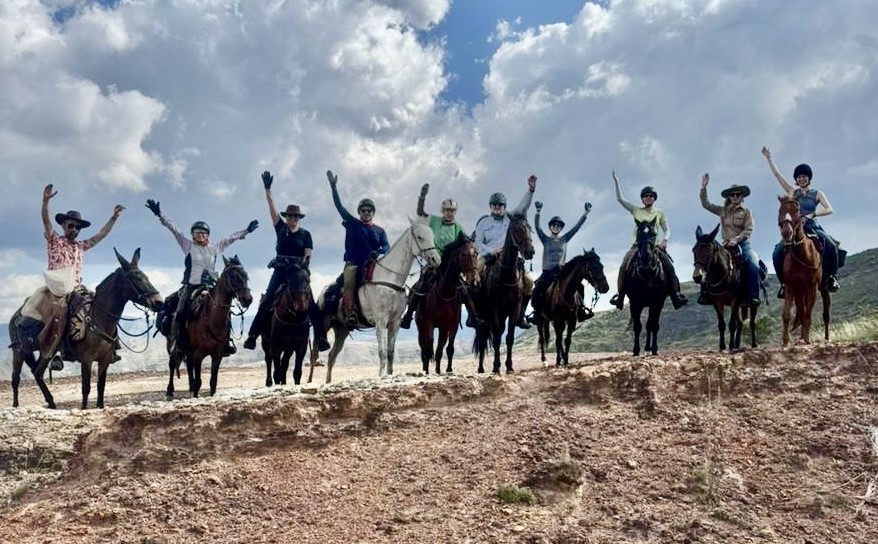
At breakfast, the first person we meet is our fellow rider Winona from Colorado. And would you believe it, Claire from Belgium at the next table is joining us too. Then, standing by the lift, is Matt from Canada. And suddenly Sascha from England and Larry, Avery and Janice from the USA are there as well. Brilliant – an international group, just the way I like it. After a bit of a ‘wait’, Bernardo, our guide, turns up, along with a minibus and driver. We’re ready to go!
On the way to an interesting saddlery, where some of us stock up on chaps and the like, and to an equestrian shop (you never know…), I’m surprised by the high petrol prices – almost double what we pay at home. But no, it’s sold by the gallon, so it’s only half as expensive. And then a road full of cows. No, not real ones, but colourfully painted Colombian showpieces, and right in the middle of it all, a stylish, colourful restaurant where, for the sake of simplicity, we order a smorgasbord of typical dishes to share and try various fruit juices. Refreshed and with a great first impression of the local cuisine, we head off to La Montera, a breeding centre for Paso Finos, some of which are cloned there and carried to term by mules. The offspring produced by conventional means are called ‘organic horses’ – learnt something new again.
After being shown the horses’ four characteristic gaits under saddle, we’re allowed to try them out for ourselves. An interesting experience, even though I must admit I didn’t quite grasp all the finer details. After all, I’d sat on a Paso Fino before. But the horses here, which are also used in competitive riding, are incomparable with their rapid cadence and extremely high leg movements.
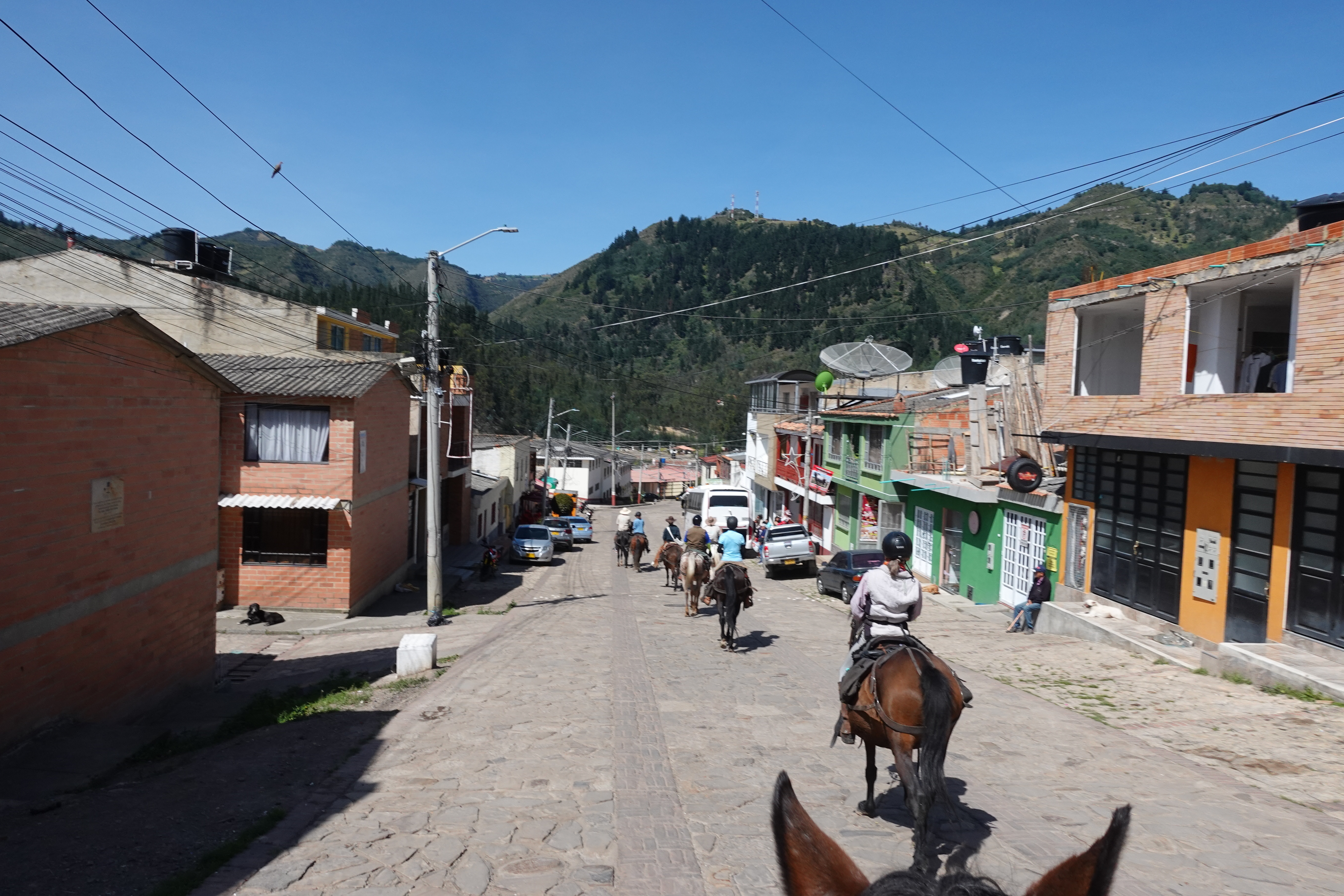
In the late afternoon, we carry on to Cucunuba, our first trail accommodation, where we arrive as the last rays of daylight fade and are greeted by four affectionate dogs – well-looked-after and cherished four-legged friends – an experience with animals that will run through the entire trip. We’re also served a lovingly prepared, sumptuous dinner in a small room just for us, with a special, old-world charm. There, we also meet another of our guides, Santiago, Bernardo’s brother.
Day 2, Sunday 12 January
As I set off for breakfast the next morning, I learn that the horses are already out in the paddock. I like them all. I rule out a few because of their size: two lovely chestnuts and an Appaloosa – surely meant for the stronger men and taller riders. A smaller one looks a bit grumpy (but isn’t – it’s just a mare), with her ears laid back. Right at the start, there’s also a mule that catches my eye. When I’m assigned mine after breakfast – it’s standing next to the ‘grumpy horse’ (which had also immediately caught my eye) – I fall straight in love with my Mariscal, a bay with a white blaze, easy to get on with and yet not too small.
Apart from Bernardo and his brother, there are three other helpers with four or five spare animals (horses and mules); a large group, all getting on well together and – as it turned out – all keeping roughly the same pace, which I consider important because it means you can swap positions every now and then.
Bernardo lovingly shows us how to approach the horses. The stirrups are
adjusted, the saddlebags filled with whatever each of us deems necessary, we mount up, and off we go for just under four hours to start with. Our four-legged friends carry us effortlessly through thickets – some of which have to be cleared with a chainsaw to make a path – up to an altitude of over 3,000 metres, where we’re treated to a laid-out lunch table with delicious food and a wide variety of drinks, served by a cheerful, professional chef who will be accompanying us throughout the tour.
In the afternoon, we ride downhill again for an hour, with a view of a lagoon. A black horse wants to join us; it seems to be enjoying our company, as it won’t let us shake it off. Bernardo eventually asks some local residents to make sure it gets back to its pasture.
At Hacienda La Casona, where we’re spending the night after riding 34 km today, coffee and cake are already waiting for us. Dinner is prepared by our hosts, whilst Barbara and I take a short walk to see our horses, which are stabled a few hundred metres away. It’s a full moon. When we return, the others are sitting in a room with an open fire, already getting in the mood for the meal in a rather splendid setting with a variety of drinks, mostly alcoholic. The accommodation was built around the year 1700. Whilst it used to be lived in by a family, it is now made available to guests.
My early night’s rest is interrupted shortly before midnight by a dog howling. ‘Of course, it’s a full moon,’ I hear someone say. But by the time I’m about to leave my room, someone else has already taken care of the poor animal and presumably found it a companion it had been missing. All is quiet once more.
Day 3, Monday 13 January.
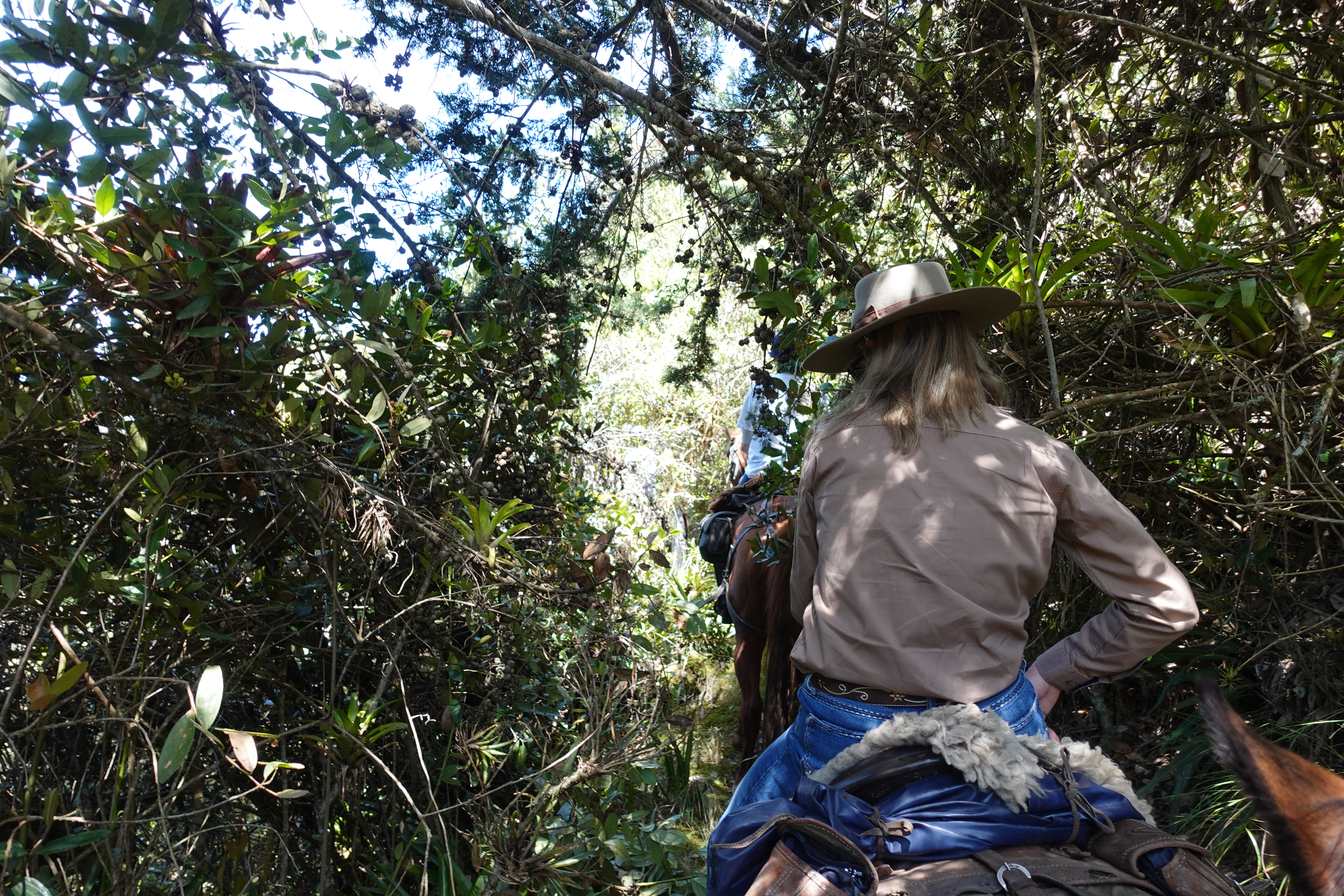
Today’s morning ride is a bit shorter. There’s plenty of time for my socks – which I’d washed the night before (due to some confusing information about a second night’s stay there) – to dry in the morning sun. We then ride for 2½ hours over very steep terrain, up and down, until we finally reach an altitude of 2,730 metres, where we enjoy a very generous picnic from our saddlebags whilst taking in the fantastic views. The two hours in the afternoon provide an opportunity for more galloping, so that I’m slowly beginning to get a feel for just how much more space my long-legged Mariscal needs compared to the others to get up to the right pace straight away.
The Hacienda la Cabana in the evening is even better than the one the day before, as everyone there (apart from the couple) has a huge single room with a king-size bed to sleep off today’s 21 km ride.
When we pop over to check on our horses briefly before dinner, we learn that a mare there had given birth to a foal shortly before our arrival, but is suffering from colic-like symptoms. The mother was successfully treated, and we spotted her out in the pasture with her foal the next morning.
Day 4, Tuesday 14 January.
So, feeling relieved, we swing ourselves into the saddle for the next four hours. First, we head for Sutatausa, where we stop at a street corner outside a bar to fortify ourselves with a beer (or something else) whilst still in the saddle, so that we’re ready for a tour (from the outside) of the nearby cathedral. Later, we pass a donkey tied to a fence. I’m careful not to get caught in its rope on the narrow path – and the donkey promptly gets its nose caught in my stirrup! Nothing budges, so I eventually have to dismount to free it. And breathe a sigh of relief: it hasn’t hurt itself.
However, several horses are said to have been injured today. First, Winona’s horse injured its hind leg because another horse stepped on it. Later, one of the extra horses was injured whilst being led by our cook – who, admittedly, isn’t all that experienced with horses – in a particularly tricky spot. But fortunately, all the injuries were only temporary.
We pass a huge water trough where the horses are allowed to drink as a reward for their tremendous climbing efforts; for the smaller ones, however, this is only possible with difficulty due to the high, stony edging. For us riders, there’s also a brief gallop up a steep slope. Mariscal copes brilliantly. Shortly after this mountain climb, there’s some molasses for the horses to eat – this time accessible to all of them. And up at an altitude of 3,050 metres, another laid table awaits us riders, with delicious food, salads, drinks and a superb view of the surrounding mountains. It comes as a complete surprise given these adventurous surroundings, and surpasses even the last few days. We enjoy the two-hour lunch break, some of us taking a little nap.
During the two-and-a-half hours in the afternoon, I try riding one of the mules, as Barbara had already started us on mule riding the day before. Absolutely impressive. Totally sure-footed, quick at a walk, without breaking into a trot unnecessarily, and – even for me as a rider – choosing its path with such care that I hardly have to dodge the branches or bend them aside with my hand. Why this well-behaved and utterly reliable animal was given the name Discordia is another matter altogether, one to do with the disappointment of an angry woman whose husband bought a mule instead of a horse.
Of course, the mules can’t quite keep up at a gallop. But we’re riding a bit more slowly now anyway, as there’s more branch-clearing with the saw to be done.
We spend the night in Ubate, where the huge dining hall attracts particular attention, as does a large mill wheel – hence the name El Molino de San Luis. Our cook has the night off this time, so the meal is prepared by the staff at the accommodation, but it’s still very tasty. After a total of 34 km today, we’re ready for a good meal.
Day 5, Wednesday 15 January.
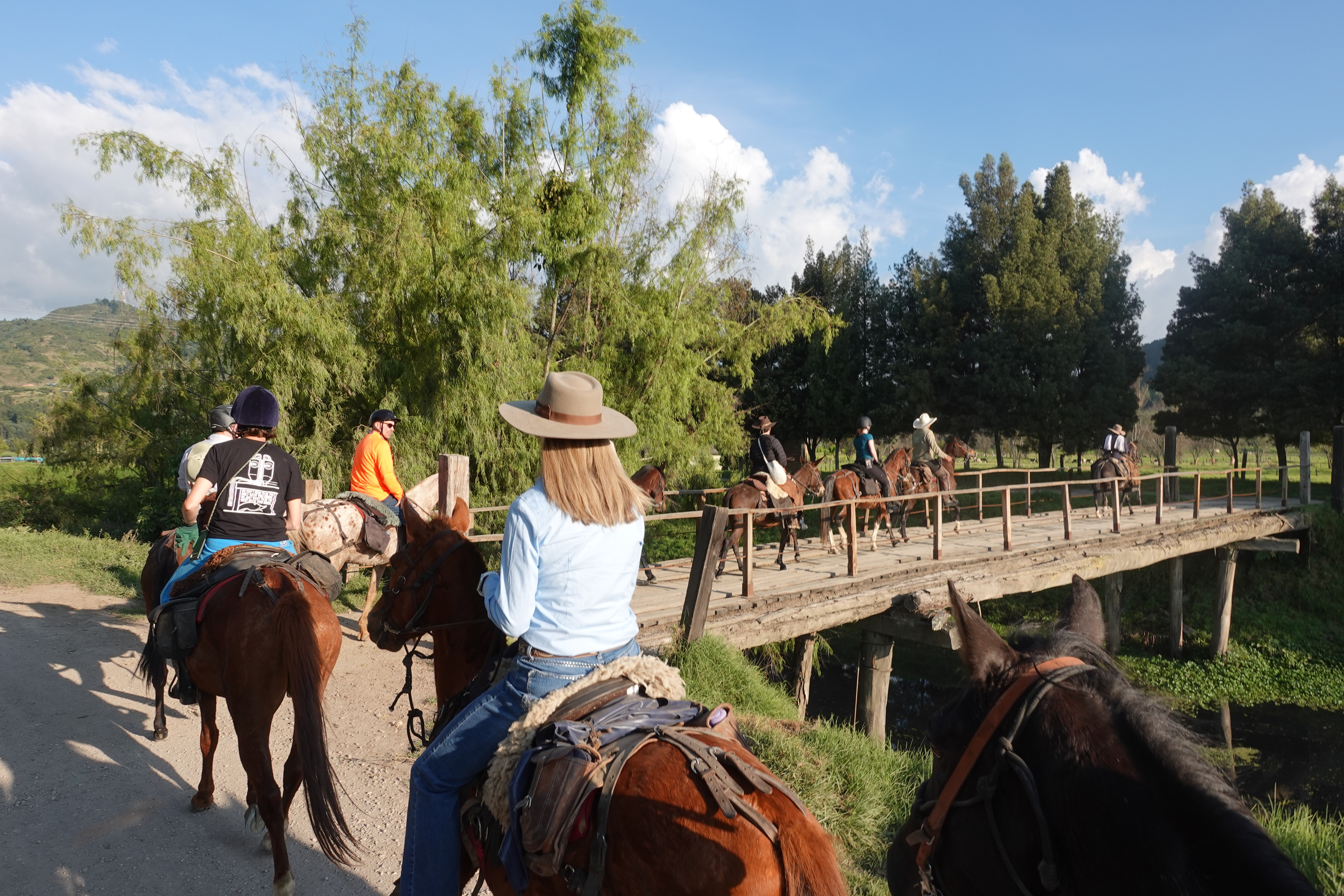
On the fourth day of riding, we’re scheduled for four hours in the morning and three in the afternoon, making a total of 35 km. In the morning, we have to tackle a climb so steep that the riding guide had already gone to check it out as a precaution earlier that morning, together with one of the other riders – as I later learnt. We have lunch at the cosy Hacienda Ticha. Afterwards, the landlady takes us to the home of an indigenous tribe, where we learn some interesting facts about the way of life of the indigenous people.
As we make our way down from the mountains, there are frequent stretches where we can gallop. Dinner is served to the usual high standard by our favourite chef at the Hacienda Potosi – which, with just two bathrooms in total, is a little less luxurious but perfectly adequate, and where we are greeted all the more warmly by three resident dogs.
Day 6, Thursday 16 January
We’d planned four hours in the saddle this morning, but it turned into five – after a short break at a farm where the horses were given something to drink and Larry’s horse was given an IV because it hadn’t drunk enough. The trails were relatively lovely, with plenty of galloping. Larry was now riding a mule to give his horse a rest.
Lunch is once again top-notch, both in terms of the food and the view. Much to the dismay of our cook (who’s dreading the next time), we feed two shy dogs. Avery, who swapped horses with Bernardo for the last hour before the break, is now riding one of the spare horses. And I join her, to give another horse a chance to be ridden and because I’m sure my Mariscal won’t mind for the remaining three-quarters of an hour. Magistrado is very keen to walk, small with eager Paso Fino strides, and thoroughly pleasant to ride. I’ve no idea whether he would have taken off at a gallop, especially as the landscape is now more open and resembles a steppe. A gallop was actually on the cards. But as we’re already right next to the Raqhira Silvestre farm, at the end of today’s 26 km ride, it doesn’t come to that.
For a change, we’re spending the night in small rooms. After dinner, a band surprises us with local folk music and encourages us to dance.
Day 7, Friday 17 January.
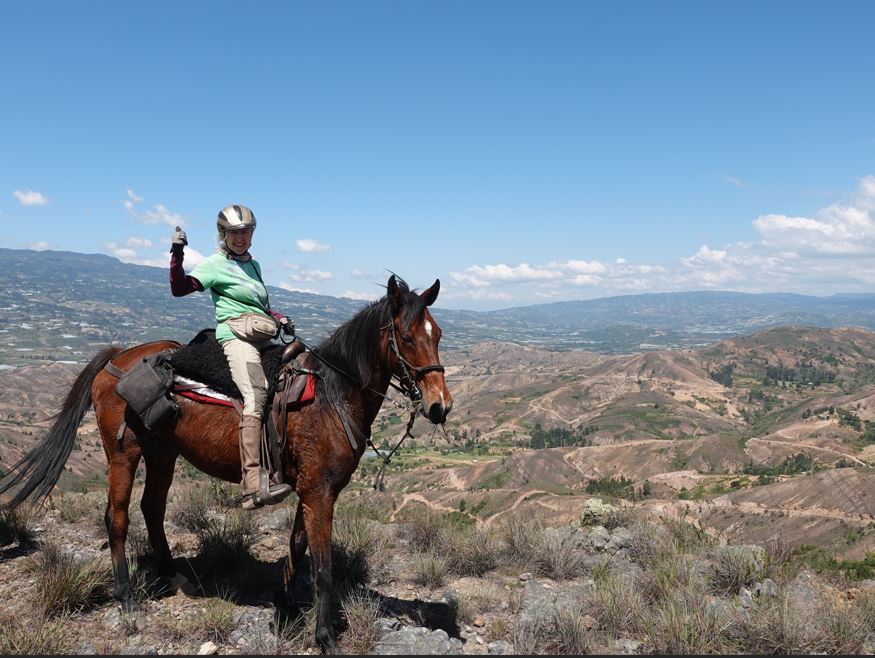
The area we ride through on the final day is particularly beautiful. The route takes us over high mountain ridges: 4½ hours in the morning and 1½ hours in the afternoon, covering a total of 35 km. We stop at a wonderful ranch where there is plenty to drink for both horses and riders.
The final gallop ends at a small stream. Just as the horses are lined up and ready for transport and we’re getting into our vehicle to head back to Villa de Leyva, it starts to rain. The first and only rain of the tour. Yes, when angels travel… And symbolic of our sadness at saying goodbye. The lovely dog who’s taken his place in the passenger seat helps us get over it; it almost seems as if he’s steering the car for the half-hour journey, so intently does he stare straight ahead
Day 8, Saturday 18 January.
The first angel, Winona, will be heading back to Bogotá the following day after a four-hour drive, and will be flying on to Panama from the airport that very afternoon. The remaining Angels will either leave their luggage at the airport for their overnight flights or drop it off at their chosen accommodation, before meeting up again in the city centre in front of the church on Plaza Simón Bolívar for a final dinner together. Afterwards, Barbara and I will set off for the airport at around 4 am to spend a few more days in the rainforest on the Pacific coast to the west – a brilliant combination, a complete contrast to horse-riding in the Colombian Andes.
www.equitour.com/col008.htm