Code |
| Euro | UK £ | US$ | MKR7D | Mounted Ranger, 7 days,dbl,fullb. | 3192.- | 2616.- | 3547.- | MKA8D | Meru-Kilimanj. Safari,8 days,dbl,fullb. | 4946.- | 4054.- | 5495.- | MKA6D | Meru-Kilimanj. Safari,6 days,dbl,fullb. | 3533.- | 2895.- | 3925.- | MKA8NP | Meru-Kilimanjaro National Park Fees | 864.- | 708.- | 960.- | MKANP | Meru-Kilimanjaro National Park Fees | 617.- | 505.- | 685.- |
|
Prices per person, not including travel
|
Notes:
Das Visum für Tansania sollte vorab elektronisch beantragt werden.Kein EZ-Zuschlag für Einzelzelt, 540 EUR/615 SFR EZ-Zuschlag für Einzelnutzung eines Doppelzelts. Änderungen der Nationalparkgebühren vorbehalten. |
In a nutshell
Webcode: MAK008Program Type: Riding Safari
Travel Time: according to date
Lodging: Farm, mobile tent camp
Catering: all meals
Accomodation: Double/twin occupancy, single occupancy or tent
Language: English, German
Non Riders: yes
Kids: upon request
Own Horse: no
Group Size
Min: 2
Max: 4
Between Meru and Kilimanjaro – a big game safari from Arusha National Park via the wildlife corridor to Kilimanjaro, a horseback safari through various wildlife areas and national parks in northern Tanzania. On your route from the lush vegetation of Meru through the savannah to the montane rainforest of Kilimanjaro, you’ll encounter a wide variety of wildlife – join us to track them down.Our bush camp offers 24 hours of nature, and our bush meals by lantern light are famous. In the evenings, you’ll gather in a cosy circle around the traditional campfire, and even then you may still spot wildlife.Arusha National Park in northern Tanzania is heavily forested and home to large numbers of buffalo, numerous giraffes, zebras, warthogs, many different species of antelope, hippos, various species of monkey – particularly the large colobus monkeys – flamingos and countless other bird species both on the water and in the air. Elephants also roam the Meru Forest – you’ll follow their trails during the horseback safari.Arusha National Park encompasses Mt Meru, Tanzania’s second-highest mountain and Africa’s third-highest free-standing mountain. Spectacular landscapes alternate: open savannah, dense forests and bushland, impressive craters and numerous lakes.
Mounted Ranger Programme:
“Join the Mounted Rangers” – this means experiencing nature conservation in East Africa as part of a dedicated team of rangers from a perspective open to only a few. Accompany the Mounted Rangers on their daily patrols through the wildlife corridor between the mighty Mount Kilimanjaro, Mount Meru, Lake Natron and Amboseli National Park. Experience everyday life in the bush alongside the rangers and their horses, learn about the challenges of wildlife conservation and contribute to the preservation of this innovative conservation project.
Itinerary
Meru-Kilimanjaro Big Game Safari 8 Days:
Day 1: Arrival and Welcome
Arrival and transfer to Dolly River Camp, which is beautifully situated on the riverbank and offers a peaceful introduction to Tanzania’s natural beauty. If you arrive early enough, you can take a stroll along the river or even go for an evening horse ride in the area.
Day 2: Ride through Arusha National Park
After breakfast, a short drive takes you to the 552-square-kilometre Arusha National Park. Despite its relatively small size, Arusha National Park is home to a wide variety of wildlife and the famous Mount Meru – Tanzania’s second-highest mountain. Breathtaking views and lush mountain forests await you. You’ll embark on an unrivalled horse-riding adventure through Arusha National Park, taking in some of the park’s most picturesque landscapes. You may spot giraffes, zebras, buffalo, bushbucks and, with a bit of luck, elephants, as well as a wide variety of birds. Keep an eye out for the playful colobus monkeys and enjoy the spectacular views of Mount Meru and the surrounding countryside. Overnight stay in comfortable hillside accommodation, surrounded by beautiful scenery
Day 3: Wildlife, culture and delightful rides
The morning begins with a ride to an enchanting waterfall, where cool mist and cascading water will provide a refreshing sensation. You’ll cross a grassy area where you may encounter herds of buffalo in their natural habitat. Now, sheltered by the dense mountain forest, the steep ascent up Mount Meru begins. At times, you’ll need to dismount to negotiate difficult sections. You’ll reach a special spot in the park: the Fig Tree Arch! This is a strangler fig, shaped like a natural arch and large enough for a rider and horse to pass through between its sprawling s and unique structure. It’s a striking landmark and provides food and shelter for birds, monkeys and insects. On the way down, you’ll stop at a viewpoint for refreshments and to enjoy the view over the National Park. On a clear day, you can even admire Mount Kilimanjaro. A picnic lunch awaits you under an iconic African Amiini tree. Cultural visit: a visit to a women’s group and a tourism school (optional) to learn more about local community-empowerment initiatives. In the afternoon, there’s a game drive to the Momella Lakes, a perfect spot for wildlife – and particularly bird – watching and photography. A canoe trip is available as an optional extra (bookable separately). As you glide across the water, you’ll get very close to the waterbirds; you might even spot some hippos. For the night, you’ll head to Masai Lodge, which offers a blend of cultural immersion and modern comfort. (The horses will be transported by lorry to a camp 15 minutes away).
Day 4: Ride across the Narco Plains Wildlife Reserve
You’ll start the day with a bush breakfast, followed by a ride through the Narco Plains, where you may encounter zebras and antelopes. You’ll soon reach the Enduimet Wildlife Management Area (WMA), a community-managed nature reserve in northern Tanzania. Covering an area of 1,282 square kilometres, it serves as an important wildlife corridor linking Amboseli National Park in Kenya with Mount Kilimanjaro and Anusha National Park in Tanzania, as well as Lake Natron with the Serengeti to the west. Thanks to these conservation efforts, the WMA is home to a diverse range of wildlife, including elephants, zebras, giraffes and various species of antelope, as well as predators such as lions, cheetahs, leopards and wild dogs. You will also be able to enjoy breathtaking views of Mount Kilimanjaro and Mount Meru. At the same time, you’ll have a unique opportunity to learn about the lives of the local Maasai communities, who graze their cattle in the same habitat, often in close proximity to the wildlife. You’ll have lunch near the WMA headquarters. During a visit with the rangers, you’ll learn more about their activities, including rescue operations, particularly those involving elephants. In the evening, you’ll reach the camp on the Ngasurai Plains on horseback. Experience your first night in the bush, with tents surrounding the paddocks and guarded by Maasai warriors. Listen to the calls of nearby wildlife beneath the glittering starry sky.
Day 5: Plains & Peaks
Today, a scenic ride awaits you. As you ride through the open countryside, you’ll catch sight of Kilimanjaro, Mount Meru, Mount Longido and the Seven Sisters. This region serves as an important wildlife corridor shared by Maasai herders and savannah animals. Lunch & Siesta: Stop for lunch near the Seven Sisters and enjoy a relaxing siesta. In the afternoon, you’ll set off for camp, where you can enjoy a breathtaking sunset over Kilimanjaro.
Days 6 and 7: Elephant Area
Wild riding adventures: Cross salt pans, which are ideal for gentle gallops, and pass Lake Amboseli near the Kenyan border before riding along the Kitenden Corridor. The Kitenden & Sinya wildlife corridor is crucial for elephant migration and enables safe passage between Amboseli and Enduimet, particularly during the dry season. The landscape is characterised by vast open plains, scattered acacia trees and a diverse range of wildlife, including predators. The legendary elephants of Sinya: this area is famous for its ancient elephant bulls, known as ‘Supertuskers’, which boast some of the largest tusks in Africa. Sinya offers a secluded, unspoilt experience away from mass tourism, making it ideal for adventurers venturing off the beaten track. Follow elephant tracks and spot savannah wildlife – with a bit of luck, you might even spot big cats. Learn more about this vital ecosystem, which links Mount Kilimanjaro, Lake Natron, the Serengeti and Amboseli. You’ll spend the night in a mobile safari camp.
Day 8: Departure
On the final day, enjoy another morning ride to spot the elusive Supertuskers. After breakfast, you’ll say your goodbyes and be transferred to the airport.
6-day itinerary:
Day 1: Arrival: Pick-up from Kilimanjaro International Airport and transfer to the Maasai Lodge.Check into your room at the Maasai Lodge, which offers a blend of cultural immersion and modern comfort.If you arrive early enough, you can enjoy one of the activities offered by the lodge: spear throwing, sundowner dances, Maasai storytelling, a nature walk or a visit to a Maasai school.
Day 2: Horse ride across the plains and wildlife reserves: Morning: Start the day with a bush breakfast, followed by a horse ride through the Narco Plains, where you may encounter zebras and antelopes roaming freely. You will soon reach the Enduimet Wildlife Management Area (WMA), a community-managed nature reserve in northern Tanzania. Covering an area of 1,282 square kilometres, Enduimet serves as an important wildlife corridor linking Amboseli National Park (Kenya) with Kilimanjaro and Arusha National Parks in Tanzania, as well as Lake Natron and the Serengeti to the west. Thanks to its protected status, Enduimet is home to elephants, zebras, giraffes, various antelope species and even predators such as lions, cheetahs, leopards and wild dogs. The area offers breathtaking views of Kilimanjaro and Mount Meru, whilst also providing an insight into the way of life of the Maasai, as local communities graze their livestock in close proximity to the wildlife. Lunch: Enjoy a meal near the headquarters of the Enduimet Wildlife Management Area. Ranger visit: Tour the headquarters and watch a presentation on the rangers’ work,
including wildlife rescue operations, particularly for elephants. Evening ride: Continue to your camp on the Ngasurai Plains for your first night in the bush, where tents surround the horse paddock and Maasai warriors keep watch under the starry sky.
Day 3: Plains and Peaks: After breakfast, you’ll ride through picturesque landscapes: Heading north, through open plains framed by Kilimanjaro (to the east), Mount Meru (to the south), Mount Longido (to the west) and the ‘Seven Sisters’ (to the north). This region serves as an important wildlife corridor shared by Maasai herders and savannah animals.Lunch & Siesta: Stop for lunch near the Seven Sisters and enjoy a relaxing siesta. Afternoon ride: Continue on to your camp for the night, which offers a breathtaking view of the sunset over Kilimanjo.
Days 4 and 5: Elephant Country: Wild riding adventures: Cross salt pans, which are ideal for gentle gallops, and pass Lake Amboseli near the Kenyan border before riding along the Kitenden Corridor. The Kitenden & Sinya wildlife corridor is vital for elephant migration and enables safe passage between Amboseli and Enduimet, particularly during the dry season. The landscape is characterised by vast open plains, scattered acacia trees and a diverse range of wildlife, including predators. The legendary elephants of Sinya: This area is famous for its ancient bull elephants, known as ‘Supertuskers’, which boast some of the largest tusks in Africa.
Sinya offers a secluded, unspoilt experience away from mass tourism, making it ideal for adventurers venturing off the beaten track. Follow elephant tracks and spot savannah wildlife – with a bit of luck, you might even spot big cats. Learn more about this vital ecosystem, which links Mount Kilimanjaro, Lake Natron, the Serengeti and Amboseli. You’ll spend the night in a mobile safari camp.
Day 6: Departure: Early morning ride: Enjoy one last early-morning ride through the picturesque landscape. Breakfast & farewell: Round off your adventure with a hearty breakfast before saying goodbye to your horses and fellow riders.
Transfer: Depending on your flight schedule, a transfer to the airport will be organised
Mounted Rancher Programme (7 days):
Day 1: Arrival at Kilimanjaro International Airport and transfer – depending on your arrival time – directly to the Mounted Ranger Base Camp on Kilimanjaro or to Makoa Farm. Welcome and an initial briefing on the week ahead.
Day 2: Introduction to the nature conservation project, getting to know the ranger team and the horses, and a safety briefing. Following an initial introduction to horse care and equipment, the afternoon will feature a ride to assess riding ability. Around the campfire, the rangers will talk about their work and the importance of the Mounted Rangers for wildlife conservation.
Day 3: Early in the morning, a full-day patrol to the Enduimet Wildlife Management Area begins. The ranger trainees learn about wildlife monitoring, tracking and patrol techniques, and experience the rangers’ daily lives first-hand. After a bush picnic, the ride leads to the ranger headquarters, where the camp will be based for the next three nights.
Day 4: Today’s patrol takes us through Maasai villages, offering insights into the coexistence of humans and wildlife as well as traditional livestock farming. In the afternoon, the programme includes horse care, equipment and saddle maintenance, and a visit to the ranger headquarters with information on projects and nature conservation and wildlife protection activities. Anyone who wishes to can help the camp cook prepare dinner.
Day 5: Together with the rangers, the ranger trainees take part in wildlife monitoring, document animal sightings, learn how to read tracks and discuss measures to prevent poaching. They also visit areas with potential human–wildlife conflicts. The day ends with an evaluation of the observations and a campfire discussion about the rangers’ daily routine.
Day 6: Today, participants experience an active patrol day involving navigation, tracking, wildlife identification and various rider-horse team tasks. By this point, the ranger trainees have been gripped by competitive spirit and the tasks are great fun. After a bush picnic, the final patrol leads back to base camp on Kilimanjaro, where the week draws to a close with a farewell dinner together
Day 7: After tending to the horses and – depending on the time – a final ride, the participants receive their Mounted Ranger Supporter Certificate, souvenir photos and a summary of the conservation activities available on request as a 9-day programme, including 3 nights in South Amboseli: longer riding sessions with patrols, elephant tracking (this is an elephant corridor) . Introduction to an elephant first-aid programme. Additional community conservation projects, e.g. rabies vaccinations for Maasai herding dogs.
(Subject to change at any time.)
Accomodation
On the farm you will spend the night in a guest house/room or luxurious cottages, and on the road in your own camp, which is set up early by the team. This consists of large, spacious canvas dome tents (standing height) in safari style, equipped with comfortable mattresses and proper bedding (blankets & pillows). The tents have enough space for luggage and you can still move around the mattresses without any problems. Even in the African bush, the evening hot shower - under the stars or in the shower tent - is available! The classic safari shower consists of a canvas bag with shower head and 10 liters of warm water per person, soap and towels are provided.
Saddle & Tack:
The bridles are bitless, Hackamore and sidepulls. Comfortable trail riding saddles.
Experience: For the Riding safari you should be in good physical condition, absolutely saddle fit and confident outside of the area, as the terrain is very varied and sometimes difficult (including small jumps over rivers and ditches). You must be fit enough to trot or canter for at least 10 minutes at a stretch. Riding time: 4-6 hours a day. Rider weight up to approx. 90 kg.
Horses:
Horses of different breeds, from Boer horses, riding ponies to warmbloods, stock from 142 cm to 168 cm. They are kept in an open stable with constant access to pasture. They are very balanced, persistent and willing. From very calm and level-headed to demanding, there is something for every rider's taste. Your hosts, a German veterinary couple, attach the utmost importance to the welfare of the horses. They are lovingly trained and are sensitive to to ride and handling.
In a nutshell
Webcode: MAK008Program Type: Riding Safari
Travel Time: according to date
Lodging: Farm, mobile tent camp
Catering: all meals
Accomodation: Double/twin occupancy, single occupancy or tent
Language: English, German
Non Riders: yes
Kids: upon request
Own Horse: no
Group Size
Min: 2
Max: 4
All itineraries, prices & dates subject to changes © EQUITOUR International Riding Vacations, Switzerland
This Site is using Cookies. If you continue browsing this site we understand that you agree with our privacy statement. read more
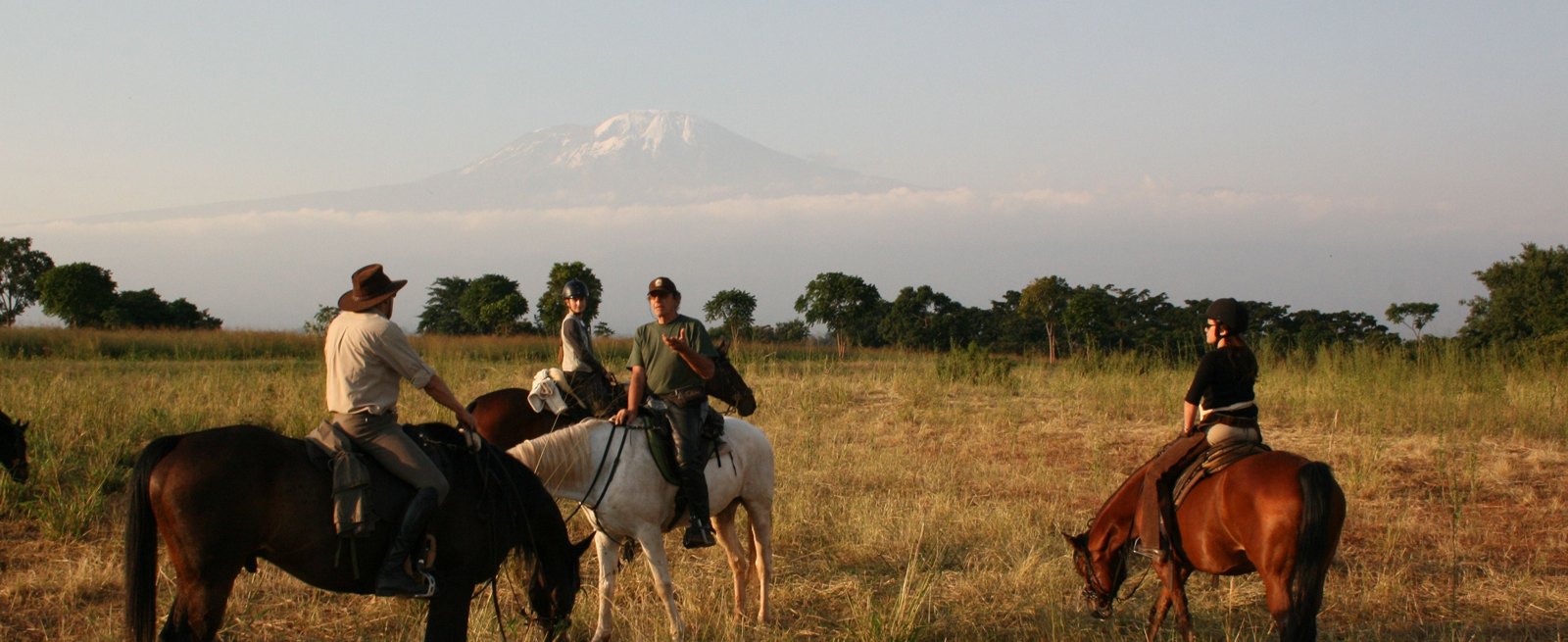
Riding Safari | Meru-Kilimanjaro Big Game Safari
Exciting Riding safari between Mt. Meru, Arusha National Park and Kilimanjaro (8 days)
Kurzinformation
Webcode: MAK008
Programmart: Riding Safari
Reisezeit: according to date
Unterkunft: Farm, mobile tent camp
Verpflegung: all meals
Zimmer: Double/twin occupancy, single occupancy or tent
Sprache: English, German
Nichtreiter: yes
Kinder: upon request
Eigenes Pferd: no
Gruppengrösse / Mitreiter
Min: 2 Max: 4
Beschreibung & Reiseverlauf
Between Meru and Kilimanjaro – a big game safari from Arusha National Park via the wildlife corridor to Kilimanjaro, a horseback safari through various wildlife areas and national parks in northern Tanzania. On your route from the lush vegetation of Meru through the savannah to the montane rainforest of Kilimanjaro, you’ll encounter a wide variety of wildlife – join us to track them down.Our bush camp offers 24 hours of nature, and our bush meals by lantern light are famous. In the evenings, you’ll gather in a cosy circle around the traditional campfire, and even then you may still spot wildlife.Arusha National Park in northern Tanzania is heavily forested and home to large numbers of buffalo, numerous giraffes, zebras, warthogs, many different species of antelope, hippos, various species of monkey – particularly the large colobus monkeys – flamingos and countless other bird species both on the water and in the air. Elephants also roam the Meru Forest – you’ll follow their trails during the horseback safari.Arusha National Park encompasses Mt Meru, Tanzania’s second-highest mountain and Africa’s third-highest free-standing mountain. Spectacular landscapes alternate: open savannah, dense forests and bushland, impressive craters and numerous lakes.
Mounted Ranger Programme:
“Join the Mounted Rangers” – this means experiencing nature conservation in East Africa as part of a dedicated team of rangers from a perspective open to only a few. Accompany the Mounted Rangers on their daily patrols through the wildlife corridor between the mighty Mount Kilimanjaro, Mount Meru, Lake Natron and Amboseli National Park. Experience everyday life in the bush alongside the rangers and their horses, learn about the challenges of wildlife conservation and contribute to the preservation of this innovative conservation project.
Reiseverlauf
Meru-Kilimanjaro Big Game Safari 8 Days:
Day 1: Arrival and Welcome
Arrival and transfer to Dolly River Camp, which is beautifully situated on the riverbank and offers a peaceful introduction to Tanzania’s natural beauty. If you arrive early enough, you can take a stroll along the river or even go for an evening horse ride in the area.
Day 2: Ride through Arusha National Park
After breakfast, a short drive takes you to the 552-square-kilometre Arusha National Park. Despite its relatively small size, Arusha National Park is home to a wide variety of wildlife and the famous Mount Meru – Tanzania’s second-highest mountain. Breathtaking views and lush mountain forests await you. You’ll embark on an unrivalled horse-riding adventure through Arusha National Park, taking in some of the park’s most picturesque landscapes. You may spot giraffes, zebras, buffalo, bushbucks and, with a bit of luck, elephants, as well as a wide variety of birds. Keep an eye out for the playful colobus monkeys and enjoy the spectacular views of Mount Meru and the surrounding countryside. Overnight stay in comfortable hillside accommodation, surrounded by beautiful scenery
Day 3: Wildlife, culture and delightful rides
The morning begins with a ride to an enchanting waterfall, where cool mist and cascading water will provide a refreshing sensation. You’ll cross a grassy area where you may encounter herds of buffalo in their natural habitat. Now, sheltered by the dense mountain forest, the steep ascent up Mount Meru begins. At times, you’ll need to dismount to negotiate difficult sections. You’ll reach a special spot in the park: the Fig Tree Arch! This is a strangler fig, shaped like a natural arch and large enough for a rider and horse to pass through between its sprawling s and unique structure. It’s a striking landmark and provides food and shelter for birds, monkeys and insects. On the way down, you’ll stop at a viewpoint for refreshments and to enjoy the view over the National Park. On a clear day, you can even admire Mount Kilimanjaro. A picnic lunch awaits you under an iconic African Amiini tree. Cultural visit: a visit to a women’s group and a tourism school (optional) to learn more about local community-empowerment initiatives. In the afternoon, there’s a game drive to the Momella Lakes, a perfect spot for wildlife – and particularly bird – watching and photography. A canoe trip is available as an optional extra (bookable separately). As you glide across the water, you’ll get very close to the waterbirds; you might even spot some hippos. For the night, you’ll head to Masai Lodge, which offers a blend of cultural immersion and modern comfort. (The horses will be transported by lorry to a camp 15 minutes away).
Day 4: Ride across the Narco Plains Wildlife Reserve
You’ll start the day with a bush breakfast, followed by a ride through the Narco Plains, where you may encounter zebras and antelopes. You’ll soon reach the Enduimet Wildlife Management Area (WMA), a community-managed nature reserve in northern Tanzania. Covering an area of 1,282 square kilometres, it serves as an important wildlife corridor linking Amboseli National Park in Kenya with Mount Kilimanjaro and Anusha National Park in Tanzania, as well as Lake Natron with the Serengeti to the west. Thanks to these conservation efforts, the WMA is home to a diverse range of wildlife, including elephants, zebras, giraffes and various species of antelope, as well as predators such as lions, cheetahs, leopards and wild dogs. You will also be able to enjoy breathtaking views of Mount Kilimanjaro and Mount Meru. At the same time, you’ll have a unique opportunity to learn about the lives of the local Maasai communities, who graze their cattle in the same habitat, often in close proximity to the wildlife. You’ll have lunch near the WMA headquarters. During a visit with the rangers, you’ll learn more about their activities, including rescue operations, particularly those involving elephants. In the evening, you’ll reach the camp on the Ngasurai Plains on horseback. Experience your first night in the bush, with tents surrounding the paddocks and guarded by Maasai warriors. Listen to the calls of nearby wildlife beneath the glittering starry sky.
Day 5: Plains & Peaks
Today, a scenic ride awaits you. As you ride through the open countryside, you’ll catch sight of Kilimanjaro, Mount Meru, Mount Longido and the Seven Sisters. This region serves as an important wildlife corridor shared by Maasai herders and savannah animals. Lunch & Siesta: Stop for lunch near the Seven Sisters and enjoy a relaxing siesta. In the afternoon, you’ll set off for camp, where you can enjoy a breathtaking sunset over Kilimanjaro.
Days 6 and 7: Elephant Area
Wild riding adventures: Cross salt pans, which are ideal for gentle gallops, and pass Lake Amboseli near the Kenyan border before riding along the Kitenden Corridor. The Kitenden & Sinya wildlife corridor is crucial for elephant migration and enables safe passage between Amboseli and Enduimet, particularly during the dry season. The landscape is characterised by vast open plains, scattered acacia trees and a diverse range of wildlife, including predators. The legendary elephants of Sinya: this area is famous for its ancient elephant bulls, known as ‘Supertuskers’, which boast some of the largest tusks in Africa. Sinya offers a secluded, unspoilt experience away from mass tourism, making it ideal for adventurers venturing off the beaten track. Follow elephant tracks and spot savannah wildlife – with a bit of luck, you might even spot big cats. Learn more about this vital ecosystem, which links Mount Kilimanjaro, Lake Natron, the Serengeti and Amboseli. You’ll spend the night in a mobile safari camp.
Day 8: Departure
On the final day, enjoy another morning ride to spot the elusive Supertuskers. After breakfast, you’ll say your goodbyes and be transferred to the airport.
6-day itinerary:
Day 1: Arrival: Pick-up from Kilimanjaro International Airport and transfer to the Maasai Lodge.Check into your room at the Maasai Lodge, which offers a blend of cultural immersion and modern comfort.If you arrive early enough, you can enjoy one of the activities offered by the lodge: spear throwing, sundowner dances, Maasai storytelling, a nature walk or a visit to a Maasai school.
Day 2: Horse ride across the plains and wildlife reserves: Morning: Start the day with a bush breakfast, followed by a horse ride through the Narco Plains, where you may encounter zebras and antelopes roaming freely. You will soon reach the Enduimet Wildlife Management Area (WMA), a community-managed nature reserve in northern Tanzania. Covering an area of 1,282 square kilometres, Enduimet serves as an important wildlife corridor linking Amboseli National Park (Kenya) with Kilimanjaro and Arusha National Parks in Tanzania, as well as Lake Natron and the Serengeti to the west. Thanks to its protected status, Enduimet is home to elephants, zebras, giraffes, various antelope species and even predators such as lions, cheetahs, leopards and wild dogs. The area offers breathtaking views of Kilimanjaro and Mount Meru, whilst also providing an insight into the way of life of the Maasai, as local communities graze their livestock in close proximity to the wildlife. Lunch: Enjoy a meal near the headquarters of the Enduimet Wildlife Management Area. Ranger visit: Tour the headquarters and watch a presentation on the rangers’ work,
including wildlife rescue operations, particularly for elephants. Evening ride: Continue to your camp on the Ngasurai Plains for your first night in the bush, where tents surround the horse paddock and Maasai warriors keep watch under the starry sky.
Day 3: Plains and Peaks: After breakfast, you’ll ride through picturesque landscapes: Heading north, through open plains framed by Kilimanjaro (to the east), Mount Meru (to the south), Mount Longido (to the west) and the ‘Seven Sisters’ (to the north). This region serves as an important wildlife corridor shared by Maasai herders and savannah animals.Lunch & Siesta: Stop for lunch near the Seven Sisters and enjoy a relaxing siesta. Afternoon ride: Continue on to your camp for the night, which offers a breathtaking view of the sunset over Kilimanjo.
Days 4 and 5: Elephant Country: Wild riding adventures: Cross salt pans, which are ideal for gentle gallops, and pass Lake Amboseli near the Kenyan border before riding along the Kitenden Corridor. The Kitenden & Sinya wildlife corridor is vital for elephant migration and enables safe passage between Amboseli and Enduimet, particularly during the dry season. The landscape is characterised by vast open plains, scattered acacia trees and a diverse range of wildlife, including predators. The legendary elephants of Sinya: This area is famous for its ancient bull elephants, known as ‘Supertuskers’, which boast some of the largest tusks in Africa.
Sinya offers a secluded, unspoilt experience away from mass tourism, making it ideal for adventurers venturing off the beaten track. Follow elephant tracks and spot savannah wildlife – with a bit of luck, you might even spot big cats. Learn more about this vital ecosystem, which links Mount Kilimanjaro, Lake Natron, the Serengeti and Amboseli. You’ll spend the night in a mobile safari camp.
Day 6: Departure: Early morning ride: Enjoy one last early-morning ride through the picturesque landscape. Breakfast & farewell: Round off your adventure with a hearty breakfast before saying goodbye to your horses and fellow riders.
Transfer: Depending on your flight schedule, a transfer to the airport will be organised
Mounted Rancher Programme (7 days):
Day 1: Arrival at Kilimanjaro International Airport and transfer – depending on your arrival time – directly to the Mounted Ranger Base Camp on Kilimanjaro or to Makoa Farm. Welcome and an initial briefing on the week ahead.
Day 2: Introduction to the nature conservation project, getting to know the ranger team and the horses, and a safety briefing. Following an initial introduction to horse care and equipment, the afternoon will feature a ride to assess riding ability. Around the campfire, the rangers will talk about their work and the importance of the Mounted Rangers for wildlife conservation.
Day 3: Early in the morning, a full-day patrol to the Enduimet Wildlife Management Area begins. The ranger trainees learn about wildlife monitoring, tracking and patrol techniques, and experience the rangers’ daily lives first-hand. After a bush picnic, the ride leads to the ranger headquarters, where the camp will be based for the next three nights.
Day 4: Today’s patrol takes us through Maasai villages, offering insights into the coexistence of humans and wildlife as well as traditional livestock farming. In the afternoon, the programme includes horse care, equipment and saddle maintenance, and a visit to the ranger headquarters with information on projects and nature conservation and wildlife protection activities. Anyone who wishes to can help the camp cook prepare dinner.
Day 5: Together with the rangers, the ranger trainees take part in wildlife monitoring, document animal sightings, learn how to read tracks and discuss measures to prevent poaching. They also visit areas with potential human–wildlife conflicts. The day ends with an evaluation of the observations and a campfire discussion about the rangers’ daily routine.
Day 6: Today, participants experience an active patrol day involving navigation, tracking, wildlife identification and various rider-horse team tasks. By this point, the ranger trainees have been gripped by competitive spirit and the tasks are great fun. After a bush picnic, the final patrol leads back to base camp on Kilimanjaro, where the week draws to a close with a farewell dinner together
Day 7: After tending to the horses and – depending on the time – a final ride, the participants receive their Mounted Ranger Supporter Certificate, souvenir photos and a summary of the conservation activities available on request as a 9-day programme, including 3 nights in South Amboseli: longer riding sessions with patrols, elephant tracking (this is an elephant corridor) . Introduction to an elephant first-aid programme. Additional community conservation projects, e.g. rabies vaccinations for Maasai herding dogs.
(Subject to change at any time.)
Unterkunft
On the farm you will spend the night in a guest house/room or luxurious cottages, and on the road in your own camp, which is set up early by the team. This consists of large, spacious canvas dome tents (standing height) in safari style, equipped with comfortable mattresses and proper bedding (blankets & pillows). The tents have enough space for luggage and you can still move around the mattresses without any problems. Even in the African bush, the evening hot shower - under the stars or in the shower tent - is available! The classic safari shower consists of a canvas bag with shower head and 10 liters of warm water per person, soap and towels are provided.
Pferde, Reiten & Zaumzeug
Pferde:
Horses of different breeds, from Boer horses, riding ponies to warmbloods, stock from 142 cm to 168 cm.
They are kept in an open stable with constant access to pasture. They are very balanced, persistent and willing. From very calm and level-headed to demanding, there is something for every rider's taste.
Your hosts, a German veterinary couple, attach the utmost importance to the welfare of the horses. They are lovingly trained and are sensitive to to ride and handling.
Sattel & Zaum:
The bridles are bitless, Hackamore and sidepulls. Comfortable trail riding saddles.
Reiterfahrung: For the Riding safari you should be in good physical condition, absolutely saddle fit and confident outside of the area, as the terrain is very varied and sometimes difficult (including small jumps over rivers and ditches). You must be fit enough to trot or canter for at least 10 minutes at a stretch. Riding time: 4-6 hours a day.
Rider weight up to approx. 90 kg.
Kundenmeinungen & weitere Informationen
Kundenmeinungen, Informationen zum Land (wie z.B. Visabestimmungen) und Wetterinfos finden Sie bei und nur online, da sich diese täglich ändern können. Gehen Sie dafür bitte online auf www.equitour.com/mak008.htm
Preise & Termine
2027
Dates, prices, prestations
Meru-Kilimanjaro Big Game Safari
To book, please click on the date or period. Red: fully booked! Yellow: limited availability!
|
Dates |
|
Services and notations |
|
Included: 6 days/5 nights (1 night in Double/twin occupancy on the farm with shower/WC, 4 nights in tent camp), all meals, non-alcoholic drinks, 4 riding days, luggage transfer, transfer from/to airport, German & English speaking support
Arrival / departure: Bookable at any time from 2 persons.
Kilimanjaro Airport (JRO).
Not included in package: Gratuities, visa, national park fees, extension to 8 days on request
|
Prices |
Code |
| Euro | UK £ | US$ | MKR7D | Mounted Ranger, 7 days,dbl,fullb. | coming soon | coming soon | coming soon | MKA8D | Meru-Kilimanj. Safari,8 days,dbl,fullb. | coming soon | coming soon | coming soon | MKA6D | Meru-Kilimanj. Safari,6 days,dbl,fullb. | coming soon | coming soon | coming soon | MKA8NP | Meru-Kilimanjaro National Park Fees | coming soon | coming soon | coming soon | MKANP | Meru-Kilimanjaro National Park Fees | coming soon | coming soon | coming soon |
|
2027 Prices per person, not including travel
|
|
You can obtain a visa for Tanzania on arrival at the airport (approx. 50 USD). 65 EUR/60 SFR per night for a guaranteed single tent. National park fees are subject to change.
Mounted Rancher Programme: plus a 900 USD wildlife conservation fee; available for groups of one or more people with a surcharge of 764,- EUR,
|
2026
Dates, prices, prestations
Meru-Kilimanjaro Big Game Safari
Space available? Click on a date and see. Afterwards you can book directly online!
|
Dates |
|
Services and notations |
Included: 8 days/7 nights, 2 nights accommodation at the farm, 4 nights fly-camp, 1 night lodge accommodation, all meals, snacks, tea, coffee and beverages*, horses incl. tack, transfers to and from Makoa Farm from Kilimanjaro International Airport or Moshi, luggage transfers where necessary, English & German speaking guide.
Arrival / departure: Arrive until 8 pm, Departure at 10 am (no transfer between 10 pm and 6 am).
Airport: Kilimanjaro Airport (JRO)
Not included in package: Trinkgelder, Visum, Nationalparkgebühren. |
|
Prices |
Code |
| Euro | UK £ | US$ | MKR7D | Mounted Ranger, 7 days,dbl,fullb. | 3192.- | 2616.- | 3547.- | MKA8D | Meru-Kilimanj. Safari,8 days,dbl,fullb. | 4946.- | 4054.- | 5495.- | MKA6D | Meru-Kilimanj. Safari,6 days,dbl,fullb. | 3533.- | 2895.- | 3925.- | MKA8NP | Meru-Kilimanjaro National Park Fees | 864.- | 708.- | 960.- | MKANP | Meru-Kilimanjaro National Park Fees | 617.- | 505.- | 685.- |
|
Prices per person, not including travel
|
Notes:
Das Visum für Tansania sollte vorab elektronisch beantragt werden.Kein EZ-Zuschlag für Einzelzelt, 540 EUR/615 SFR EZ-Zuschlag für Einzelnutzung eines Doppelzelts. Änderungen der Nationalparkgebühren vorbehalten. |
| |